Cross-Currents

January 6, 2009

Rabbi in Israel - War in Gaza

Filed by Harvey Belovski @ 8:59 am

I am sitting in the National Library at the Hebrew University on the third day of a visit to Israel. I am in here to catch up with young people from my community who are studying at various institutions in Israel, but have dedicated today, the Fast of Tevet, to rest and to some private study. Yet instead, I feel motivated to write a short post about the atmosphere here. In the interests of brevity, here are a few points that have stuck in my mind:

* Every minyan I have visited is saying a ‘Kapitl Tehillim’ - a chapter of psalms - after each service, every day, followed by a prayer for the wellbeing of Jews everywhere. For your interest, so far I have been to a shteibl in Meah Shearim, the minyan of a prominent Chassidic Rebbe, a religious Zionist Shul and the minyan at the Hebrew University library.

* There is a hand-written note pinned to the door of the lift in the building where I am staying, advertising opportunities to send non-perishable food to soldiers in Gaza. Apparently, there are many such notices, as well as those volunteering to deliver the goods.

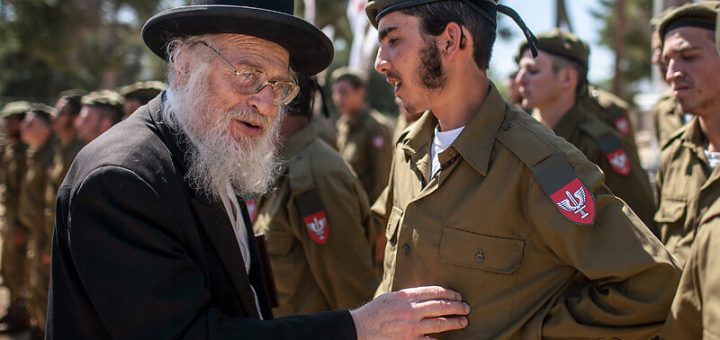
* I spoke yesterday to the head of a ‘hesder’ yeshivah; some of his students have been drafted and he is expecting most of the rest of the yeshivah to be called in the event of a prolonged or expanded conflict. This is the vision of the ‘hesder’ programme: enabling its students to combine Torah learning with military duty.

January 4, 2009

After Mumbai

Filed by Jonathan Rosenblum @ 4:42 pm

The massacre of nearly 200 civilians by a ten-man terrorist group in Mumbai, India revealed a frightening new world. First of all, the terrorists’ attack was thoroughly planned and efficiently executed, with help from elements within Pakistan’s security and intelligence services. Their tactics are replicable in every country with a substantial Muslim presence.

Second, the attack on the Chabad House revealed that every Jewish institution in the world is a potential target. The cost of guarding those institutions would be prohibitively expensive and likely ineffective, given the attackers would inevitably be better armed, better trained, and enjoy the element of surprise. Iran is believed to have sleeper terror cells all over the globe, and they will target Jewish institutions. Indeed, they already have in the 1994 bombing of the Argentinian Jewish Center in Buenos Aires, which claimed 85 lives.

Perhaps most frightening of all, the response to Mumbai showed that the West is still not prepared to acknowledge the threat of radical Islam. And it is pretty hard to confront a threat that one dare not call by name. As the news of the attack broke, Western media pretended that the religious identity of terrorists remained a mystery. U.S. media outlets even speculated that perhaps the attackers were a radical Hindu group. Yet one would have to think back a long way to a terror attack not perpetrated by Muslims.

Once the religious identity of the terrorists could no longer be denied, the media stole a page from British Home Secretary Jacqui Smith’s playbook. She has gone beyond Orwell in ordering terror committed by Moslems to be described as anti-Islamic terror because it places Islam in a bad light. (Even President George Bush has long since dropped Islamofascism from his lexicon.)

Israel Awakens

Filed by Jonathan Rosenblum @ 4:34 pm

Israel’s long-delayed response to missile attacks on its southern region began in earnest this past Shabbos. (One hopes that Shabbos was chosen because of the opportunity presented to wipe out 160 Hamas fighters at a military graduation ceremony and not out of indifference to its sanctity.) Israeli air strikes were aimed at underground rocket launchers, missile silos, ammunition dumps, and Hamas training camps. Virtually all of Hamas’s official headquarters in the Gaza Strip were destroyed. In a second day of sorties, Israel claimed to have destroyed 40 underground tunnels between Rafah, in Egyptian Sinai, and Gaza. Those tunnels have been the principal means for Hamas to bring vastly upgraded armaments into Gaza, as well as commercial goods on which Hamas exacted high taxes.

Initial reports indicate a high degree of satisfaction in the IDF with the quality of the intelligence that it succeeded in amassing concerning the location of military targets. Even Palestinian reports claimed no more than 45 civilian casualties out of the approximately 300 Gazans killed in the first two days of Israeli sorties.(Israeli reports placed the number of civilian casualties far lower.)

Despite the satisfaction in the IDF with the accuracy of the bombing and the quality of the intelli gence, the most that can be said, as we write, is that Israel has successfully reprised the first 38 minutes of the Second Lebanon War, in which much of Hizbullohs infrastructure in south Beirut was destroyed and most of the longer range missiles in its possession elinimated. But just as the next month of fighting in Lebanon in 2006 demonstrated that air strikes alone are insufficient to entirely suppress missile fire from mobile rocket launchers – Hizbullah fired more missiles on the last day of fighting than on any previous day – so it seems sure that air strikes alone will not prove sufficient to eliminate Hamas’ missile capacity for any prolonged period of time.

Meanwhile Israel has called up 6,500 reservists, moved tanks from the North to the South, and appears to be preparing for some sort of ground operation on the Gaza Strip, though of what magnitude and duration remains unclear.

The Price of Disunity

Filed by Jonathan Rosenblum @ 4:19 pm

Rabbi Zalman Sorotzkin, at the beginning of his commentary Oznaim LeTorah on parashas Vayeishev, explains the juxtaposition between the chronicles of the descendants of Yaakov and the brief enumeration of the tribes of Esav at the end of parashas Vayishlach. The Torah, writes Rabbi Sorotzkin, seeks to explain why the descendants of the Esav merited to establish a kingdom, with an orderly succession, for eight generations before Yaakov and his descendants succeeded in doing so.

He answers that the tribes of Esav, for all their individual corruption and wickedness, at least had a measure of internal unity. Though they descended from different mothers, the tribes of Esav were able to settle on a single king without recourse to warfare. The children of Yaakov, by contrast, were divided among themselves and even came to the point of fratricide. And thus they had to be purified in the crucible of Egypt before they could establish their own kingdom.

The Lutzker Rav’s vort struck with particular force this past Shabbos, following, as it did, the headlines in the weekend chareidi press about the disunity in chareidi ranks ahead of the coming elections. Both Degel HaTorah and Agudath Israel announced last week that they are planning to run as separate lists in the upcoming elections. Each side, needless to say, blamed the other for the breakdown in negotiations.

The chief stumbling block to a unified list – at least as far as one could gather from news reports – is the issue of the placement of representatives of the various factions on the Knesset list. Ideological differences, if any, it seems play little role in the failure to agree on a common list. In this context, one is reminded of a classic vort of Rabbi Moshe Sherer on one of his periodic missions to Israel to try to resolve some of the perpetual infighting in Agudath Israel. Then, as now, the issue was placement on the Knesset list. In those days, when Knesset members still had the power to allocate monies to individual institutions of their choice, the order of the various factions’ representatives could determine which institutions remained open and which closed. And so placement on the Knesset list was always bitterly contested.

Uncle Bernie as Metaphor

Filed by Jonathan Rosenblum @ 4:09 pm

Predictably, Bernie Madoff exerts an irresistible pull for columnists of all stripes – this one included. Since the scandal of history’s largest Ponzi scheme broke, he has become an all-purpose metaphor for virtually everything wrong in the world.

Unfortunately, most of those metaphors have proven about as successful as the interpretations of Pharoah’s dream offered by his necromancers: They rest on superficial parallels and could have been written about hundreds of lesser criminals.

For instance, I have seen a number of sermons circulating by modern Orthodox rabbis asking: What has become of us? Have we made wealth the measure of the Jew and turned money into in indispensable entry ticket into the fraternity of “good Jews”? Good questions, no doubt. But the Madoff scandal is not about communal greed.

Though he palled around with lots of modern Orthodox Jews – enough to rip off the community to the tune of several billion dollars – and sat on the board of Yeshiva University’s business school, Madoff never pretended to be Orthodox. Nor were those who invested with him any greedier than the rest of us.

All Hands Needed on Deck

Filed by Jonathan Rosenblum @ 3:52 pm

One of the glories of the Torah community is its extremely high rate of volunteerism. In Eretz Yisrael, for instance, virtually every major volunteer organization was founded by religious Jews.

The emphasis on volunteerism will only grow in the years to come. The current financial crisis ensures that many projects will have to run largely on volunteer power. In addition, there is a growing recognition that many of the challenges facing our community are of such a nature and magnitude that solving them will require the collective effort of the entire community.

The so-called Shidduch Crisis – the growing number of older singles who have not yet found their zivug (life partner) – falls into the latter category. Three years ago, Jeff Cohn of Baltimore sold his business in order to found the Make A Shidduch Foundation. Shidduchim 101 by Mrs. Shana Kramer is the Foundation’s most recent initiative.

The basic insight behind the book is simple: Everyone knows a number of singles, but no two people know exactly the same ones or travel in the same circles. Thus the more people who put their minds to thinking about possible matches for the singles they know the greater the pool of potential matches. Professional shadchanim may be tempted to concentrate on the low-hanging fruit – the most beautiful girls, the most brilliant boys, the most meyuchisdik or richest. Amateurs are more likely to focus on those whom they care about and who are experiencing difficulties in the process for one reason or another. In addition, they are more likely to actually know one or both of the parties they are introducing.

January 1, 2009

Moral Myopia and Journalistic Integrity

Filed by Yaakov Menken @ 3:50 pm

As we follow the current “conflict” in the Gaza Strip, it’s easy to discern who cares about the facts, who displays a genuine understanding for the realities of the situation, and who is only interested as casting the Jews and Israel as the evil aggressors. When we look at media reporting about the Orthodox community, it is similarly easy to discern who is attempting to present a balanced picture, and who is primarily interested in finding yet another opportunity to say something bad about frum Jews.

Exhibit A: The NY Jewish Week’s “Group Charged With ‘Playing G-d’ Over Genetic Testing,” Gary Rosenblatt’s one-sided slur of Dor Yeshorim, the Committee for Prevention of Genetic Diseases, a charitable organization which has done simply amazing things in behalf of the Jewish community. The facts are wrong, the science is lousy, the judgment unrealistic and poor, and the bias, self-evident and inexcusable.

Dor Yeshorim, says Rosenblatt, is no stranger to “controversy.” A more accurate statement would be that Dor Yeshorim is no stranger to bad reporting. Back in 1994, the US News & World Report accused Dor Yeshorim of practicing “eugenics,” which is both an incendiary charge in the wake of the Nazi Holocaust, and also stands truth on its head. The net effect of the Dor Yeshorim screening program is to increase the population of carriers of fatal genetic defects, by enabling carriers to marry and reproduce without giving birth to afflicted children. Time after time, reporters have demonstrated their lack of knowledge regarding how Dor Yeshorim screening works, how the stigma of being identified as a carrier is avoided, and why it is necessary.

Put briefly, there is a disconnect between what we know intellectually, and our fears. According to a geneticist MD friend of mine, it is well-established in the research community that the average person is carrying around seven “recessive lethals,” the vast majority of which result in an (often undetected) miscarriage. We are all “carriers,” and carriers of Tay-Sachs, Cystic Fibrosis or Familial Dysautonomia are no less healthy than anyone carrying any of the myriad other recessive abnormalities. But try telling that to a high school kid who’s just been told to avoid marriage with another carrier — or try explaining it to the nervous mother of a prospective spouse. And before reaching the conclusion that this is because the “insular” Orthodox are “ignorant” of human genetics, note that the U.S. Air Force dismissed 143 healthy African-American applicants because they were carriers of the Sickle-cell gene — a practice it abandoned only after being sued.

Pray for the Gazan Boy

Filed by Avi Shafran @ 12:56 pm

No, I’m neither a prophet nor a covert Israeli operative. Yes, it was only a day after I distributed a column taking the New York Times to task for refusing to call Hamas a terrorist organization that Israel launched its offensive against Hamas in Gaza. But, really, I had no foreknowledge of the fact that Israel’s leaders would do anything more in response to the shelling of its towns by Hamas and its friends than offer the sort of statements that have been issued for years after such terrorist onslaughts.

But they did do more, in the hope – may we merit its fulfillment – of crippling the infrastructure of the murderous entity to its south. And, true to form, The Times avoided the “T” word, going only so far as to identify Hamas on first mention as a group “which Israel and the United States brand as a terrorist organization.” According to informed sources, Israel and the United States have also branded the sun hot and the Pope Catholic.

Similarly true to form was Hamas itself, whose spokesman Fawzi Barhoum, according to the very aforementioned newspaper, “called for revenge in the form of strikes reaching ‘deep into the Zionist entity using all means,’ including suicide attacks.” Still no you-know-what-word, though.

There was more of interest in the paper’s reportage, too. In a dispatch by veteran Times reporters Ethan Bronner and Taghreed El-Khodary that appeared on December 30, the scene at Gaza’s Shifa Hospital was vividly brought alive.

December 28, 2008

Sean Rayment is Addicted to Bigotry

Filed by Yaakov Menken @ 6:10 pm

The reason I call your attention to this article is not so that you can have a look at an anti-Semitic diatribe in the guise of a serious position about the current state of affairs.

It is so that you can see the comments.

Britain is not known to have nearly such a strong understanding of Israel’s need to defend itself. These comments are, in that context, surprisingly heartening.

December 27, 2008

Reality Hits

Filed by Yaakov Menken @ 11:11 pm

We’ve already gone several rounds on how Bush, McCain and Obama stack up when it comes to Israel. Now that Olmert has finally decided that Kassam rockets raining on Sderot deserve a bit more than improved bomb shelters in response, all our statements about Bush’s amazingly pro-Israel position, and our concerns about Obama, are all-too-rapidly being verified. First, let’s look at the current US Administration’s response to the violence on the Israel-Hamastan border:

The U.S. on Saturday blamed the militant group Hamas for breaking a cease-fire and attacking Israel, which retaliated with strikes of its own during what became the single bloodiest day of fighting in years…

It was “completely unacceptable” for Hamas, which controls Gaza, to launch attacks on Israel after a truce lasting several months, said Gordon Johndroe, a spokesman for the National Security Council.

“These people are nothing but thugs, so Israel is going to defend its people against terrorists like Hamas that indiscriminately kill their own people,” Johndroe said in Texas as President George W. Bush was spending the week before New Year’s at his ranch here. “They need to stop. We have said in the past that they have a choice to make. You can’t have one foot in politics and one foot in terror.”

December 26, 2008

Terrorized Times

Filed by Avi Shafran @ 9:19 am

In a column published on December 14, Clark Hoyt, The New York Times’ current Public Editor, or reader representative, addressed the paper’s choice of terminology for people who target civilians with the intent of killing them.

What brought Mr. Hoyt to address the issue was the Times’ assiduous avoidance of the word “terrorist” for the perpetrators of what has come to be known as the Mumbai Massacre – the late November Islamist attacks on hotels, a hospital, a railway station, a restaurant and a Jewish center in India’s largest city that left 173 dead and more than 300 injured. The attackers were called “militants,” “gunmen,” “attackers” and “assailants” in the paper of record’s reports but never “terrorists.” Some readers were offended; thus the public editor’s investigation and report.

He explained that “in the newsroom and at overseas bureaus, especially Jerusalem, there has been a lot of soul-searching about the terminology of terrorism.” The upshot of the introspection, he continued, “to the dismay of supporters of Israel – and sometimes of the other side, denouncing Israeli military actions” is that “The Times is sparing in its use of ‘terrorist’ when reporting on that complex struggle.” (One wonders if examples of the military actions denounced by the “other side” include the recent killing of three Palestinians by Israeli forces; the three were planting explosives in northern Gaza along a border fence and, when accosted, threw hand grenades at the Israeli soldiers, who then returned fire – and the three, none too soon, to their Maker.)

Later in his essay, Mr. Hoyt takes up the issue of Hamas, the Sunni group whose charter calls for the destruction of Israel and which has launched scores of suicide attacks against Israeli civilians (targeting, among other things, buses, hotels, supermarkets and restaurants) and has fired hundreds of missiles at Israeli cities and town. The group that exults in the murder and maiming of innocent men, women and children, that trains its young to feel the same way, that denies the Holocaust and expresses confidence that, as one of its leaders put it in a Hamas newspaper, “the Holocaust is still to come upon the Jews.” Mr. Hoyt explains that The Times chooses to not label Hamas a terrorist organization “though it sponsors acts of terror against Israel.”

Top Ten Quotes About Madoff

Filed by Yitzchok Adlerstein @ 3:02 am

Well, not quite ten. So we’ll start closer to the top. What follows are some comments from around the Jewish world that struck me as particularly powerful and telling. They are presented with very little or no comment. They are all in the hameivin yavin category.

Number 4 Quote
Pinchas Landau, writing in the Jerusalem Post (December 19), writes a devastating analysis of the seriousness of the scandal. He may get the reason for Orthodox culpability wrong (see the next quote for a more accurate depiction of Orthodox wrongdoing), but he does not mince words about the extent of the damage. His analysis is reminiscent of the words of R. Shamshon Raphael Hirsch regarding the 4-5 fold penalty for stealing sheep or cattle, owing to the damage inflicted on an entire economic enterprise (i.e. animals that graze without protection) that relies on community honesty to survive.

What is abundantly clear is that Bernie Madoff is a mass-murderer. We will never know the names of the people who are going to die because of him, but he has killed numerous would-be recipients of medical care, welfare support and just plain money to pay the bills with, from the host of charities and charitable people he has wiped out; killed them as sure as if he took a gun and shot them through the heart. The bullets have been fired and will hit their anonymous targets. Some will die, others “merely” suffer from sickness, pain, poverty and the rest - all due to Madoff…

Yet it goes much further than responsibility for misery and mass-murder. Madoff committed a crime against humanity, in the most fundamental sense of that overworked and abused term. Typically, in the context of the entire financial crisis, it is the gentiles who have identified this central issue, quicker and more clearly than the Jews, including - perhaps especially - the Orthodox rules-observant but mostly morally blind “religious” Jews.

December 25, 2008

Rav Yehoshua Leiman z”l

Filed by Yitzchok Adlerstein @ 10:26 pm

Last weekend, in which the parshah we read referenced an eshkol anavim, Klal Yisrael lost an ish ha-eshkolos. Rav Yehoshua Leiman z”l was niftar after a long struggle with illness.

Separated as we were by thousands of miles (he lived in Flatbush), I did not know him well, but knew that he was remarkable the very first time I met him, at one of the first AJOP conventions. I don’t recall how we first began speaking, but it became apparent that he was a genius. (It is probably familial. Yibadel le-chayim tovim, his brother is Prof. Shnayer Leiman.) I deliberately chose the elliptical “became apparent,” because he didn’t flaunt it. He was downright easy-going, modest and accessible.

Our conversations initially were about Maharal, and spread to other sifrei machshavah. He would always challenge me – to provide a source here, refine a thought there. His Torah interests were eclectic. Although clearly self-defining as a member of the haredi Yeshivah world, he was familiar with historical and academic figures and scholarship, Rav Kook, and the philosophical works of the rishonim (the ones not studied too often any more in yeshivos).

He was extremely medakdek in halacha, carrying around a sack of personal chumros and hanhagos. (Even when he came to Los Angeles for medical treatment last summer, already in a weakened state, he refused food from all givers. He made his own arrangements for food and even its preparation. When he surprised me and took a long walk to my house on a Shabbos afternoon, I couldn’t get him to eat anything more than fresh fruit.) He lacked the somberness and distance that sometimes goes along with such dikduk. His voice was always full of life, and there was an ever-present twinkle in his eyes. He was an easy conversationalist with people from all walks of life, including those who could not keep up with him intellectually if he let out the throttle.

The Time is Now

Filed by Guest Contributor @ 12:29 pm

by Rabbi Pesach Lerner

For me, the story began about 17 years ago. I sincerely hope and pray that it ends soon.

I joined the National Council of Young Israel’s (NCYI) professional staff in October 1991. One of the first things I began doing was visiting the many Young Israel branches. During the first few years of my employment at NCYI, I visited almost all of the more than 150 Young Israel branches throughout the United States and Canada.

During that time, I heard about an event which was scheduled to take place at the Young Israel of Manhattan in the Lower East Side of New York City, which was to focus on sharing information and raising awareness about Jonathan Pollard. I thought that attending the event would be a great way to meet the members of the shul and to learn something about Jonathan Pollard, a name that I recognized but did not really know much about. I attended the event, where not only did I meet members of the shul, but I also heard a startling story about Jonathan Pollard, who spied for Israel and received a life sentence. The Pollard story bothered me, as I had too many questions and not enough answers. I started researching the Pollard story, asking questions, and inquiring into the activities of the Jewish community on his behalf.

December 19, 2008

Exceeding Our Expectations

Filed by Yaakov Menken @ 3:12 pm

Recently, a commenter reacted with both surprise and disdain to the hopeful messages here following the election of Barack Obama as our next President. Referring correctly to the fact that many of our writers — including myself — had grave reservations about Obama (the word he used was “villified” [sic]) and strongly favored McCain, he wondered how Cross-Currents writers could be “scurrying to demonstrate their moderation and seek his favor.”

The simple answer is that we did not “vilify” anyone, but referred critically to Obama’s public record — and now that the election is over, it’s time to work with our President-elect rather than against him.

During the election, I said Obama’s record on Israel worried me — and for good reason. For example, in an essay on the Middle East, paragraphs referring to Hizbollah and Hamas categorized the former, but not the latter, as a terrorist organization. Could anyone concerned for Israel’s safety not find that troubling? John McCain’s decades-long relationship with Israel is unquestioned, his attitude towards Arab terrorism consistent, and his belief in Israel’s right and need of aggressive self-defense, refreshingly frank.

But John McCain isn’t going to be our next president, and instead of focusing our energies upon water under the bridge, it is only appropriate that we look forward. It would be far from the first time that a politician dramatically exceeded expectations created from his or her past record.

December 18, 2008

Unwashed Poets and Kashrut

Filed by Avi Shafran @ 4:48 pm

Recently I was privileged to participate in a student-group organized panel presentation at Yeshiva University entitled “The Kosher Quandary: Ethics and Kashrut.” The panel included representatives of the Orthodox Union, the Rabbinical Council of America and a social justice advocacy group, Uri L’tzedek. The panelists were given a list of questions to address in their remarks, and I think, and hope, that it was an educational experience for all who attended.

Since some people seem to have imagined that I said things I didn’t, or chose to ignore things I did say, I offer my remarks below, which followed my expression of gratitude to the organizers.

I would like to make clear at the onset that, while I intend to speak clearly and bluntly tonight, nothing I say should be construed as impugning the intentions or good will of anyone. I might feel that certain actions or decisions are misguided, but I mean to judge things, not, G-d forbid, people.

Searching for the right metaphor for the relationship between ethics and kashrut, what I came up with is the relationship between… personal hygiene and poetry. Get it? Well, a great poet might never shower, but that bad habit need not affect the quality of his writing. One might not want to attend the fellow’s readings; but the Cantos are the Cantos, Ezra Pound notwithstanding. So while kosher food producers are required by halacha to act ethically in every way, any lapses on that score have no effect on the kashrut of the food they produce.

Thoughts on the Madoff Debacle

Filed by Yitzchok Adlerstein @ 4:03 am

No, he’s not Orthodox. More on that later.

Within a handful of hours after the story broke, the Nazi sites spun it as predicted. Cretins that they are (and therefore understanding nothing about where the money went), they questioned where someone could hide $50 billion. The answer is self-evident: the Zionist Jew had it all shipped to banks in Israel! The fallout would have likely been far worse if Madoff would have embezzled little old ladies in Middle America. Instead, so many of the victims were Jews. The racist and Arab sites were too busy gloating over all those Jews losing fortunes to try to spin this as the latest epilogue to the Protocols of the Elders of Zion and their plan for global domination.

Less predictable was the baseless charge that Madoff was Orthodox. Rabbi Elliot Dorff, rector of American Jewish University (formerly University of Judaism, the West Coast equivalent to the Conservative movement’s Jewish Theological Seminary) wondered how a person who davened three times a day could get it so wrong. It all goes to show, he argued, that ritual observance is not enough, and Jews must learn to incorporate ethics and morals in their behavior, rather than stay mired in empty formalism and legalism. (This is an old mantra that the Conservative movement dusts off every now and then to criticize errant Orthodox behavior. The thought, of course, is essentially correct, and very much a part of Orthodox consciousness and teaching. The implication that somehow Conservative Jews are more ethical and moral because they are not mired in halachic detail is both counterfactual and logically ludicrous.)

Although we have no dearth of scoundrels in our midst, this one did not belong to us. I challenged Brad Greenberg, the Jewish Journal’s “God Blog” master on it, and both of us checked on the facts. I reached someone in Manhattan whose name I cannot use, but knows the story and the players from the inside. “A vicious lie,” was his reaction to the claim that Madoff was Orthodox. He vigorously attested to the fact that Madoff is not in any manner of form shomer shabbos, and cannot be considered Orthodox. While it may be harder to pin the label “Conservative” or “Reform” (or Mammon worshipper?) on anyone (at this point, no one wants him in their camp), there are accepted criteria that define Orthodoxy. It is not about membership in a shul, but about observance of mitzvos, as specified in Shulchan Aruch.

December 15, 2008

The Bush I Know

Filed by Guest Contributor @ 8:57 pm

(By Noam Neusner, who was a speechwriter and Jewish liaison for President Bush from 2002-2005.)

President Bush and First Lady Laura Bush will watch Monday night as the grandsons of Harry Truman and David Ben-Gurion light a menorah on the State Floor of the White House.

It will be the eighth year the president has devoted an evening to celebrate Chanukah, and more than 600 Jewish friends and guests will celebrate with him. The White House will serve kosher food and the Marine Band will play Chanukah favorites.

Cynics will say it’s easy for presidents to do these kinds of events — that’s what all presidents do, after all. They hold nice parties and make people feel good and important.

A Rose by any Other Name

Filed by Yaakov Menken @ 7:56 pm

The NY Jewish Week noted a thread of criticism of media coverage of the terrorist attack on the Chabad of Mumbai, one both different and more subtle than the media’s obfuscation of the terrorists’ identity as Islamic radicals and their Jewish victims as deliberate targets (though, to be certain, it took note of that as well). What exercised the Jewish Week is that the news reports called the Chabad shluchim “ultra-Orthodox.” But lest you think that the NY Jewish Week took this as an opportunity for soul-searching, to perhaps finally discard its consistent use of a disparaging term to describe our community, prepare to be disappointed — for that impression would be sadly mistaken.

Mark Steyn, writing in the National Review and Washington Times (Dec. 6), noted that “ultra” was used “in almost all the western media … less a term of theological precision than a generalized code for ‘strange, weird people, nothing against them personally, but.” And Steyn adds, were these ultras “stranger or weirder than their killers?”

Mark Steyn, in this passage quoted in the NYJW, gets it exactly right. Frequent readers will note that many of us at Cross-Currents have protested the “ultra” label for exactly this reason. Steyn is not at all Orthodox himself; he just knows an offensive smear when he sees one. He correctly outlines the offensive bias inherent in the “ultra” label and calls it unfair, thus implying that it should be jettisoned from civilized discourse — and not a moment too soon.

The NYJW takes what Steyn said, twists it around, and comes out with a message that is both wrong and offensive. Associate Editor Jonathan Mark contributes no special insight to make sure Mark Steyn’s message hits home. On the contrary, to Mark there is nothing wrong with retaining the “ultra-” term in the NYJW lexicon. According to the Mark, the problem is not that the bigoted term is universally offensive and to be discarded — rather, it is that Chabad Chassidim aren’t “ultras.” He attempts to take Chabad out of the world of charedi Judaism, something which neither Lubavitchers nor anyone else should find acceptable.

December 14, 2008

The Gift of Simchah

Filed by Jonathan Rosenblum @ 4:26 pm

Each of us knows at least one. I mean someone who inevitably makes you feel happier, more inclined to do something nice for the next person you meet, just by spending a few moments in their presence. Someone who radiates simchas hachaim.

Simchas hachaim bears no resemblance to the hale-fellow-well-met jocularity of a successful politician – an external garb. It is a quality that wells up from within and is incapable of being contained within one body, but must burst forth and be shared with others. It is expressed in a warm smile, a natural inclination to judge others favorably, optimism, and a strong desire to help others.

Take my former optician Mr. Rosenberg, for instance. I never saw him without a gentle, knowing smile on his lips. And he never showed any sign of pressure, even when someone who had not purchased glasses from him came in looking for a tiny screw to hold the earpiece. He would just take out his plastic box containing hundreds of such screws and patiently try one after another until he found the right one. Then he would inevitably waive payment, even though fiddling with a series of tiny screws would be an ordeal even for someone whose fingers were not in their seventh or eighth decade.

Those rare individuals whose simchas hachaim never deserts them play a vastly disproportionate role in our society. Like a rock hitting the water, they send off waves of positive energy in every direction. Social scientists have begun to confirm this insight. A new study in a leading British medical journal describes how much of our emotional state is collective – i.e., determined by the emotions of those around us, even those from whom we are two or three degrees removed. One person’s happiness triggers “an emotional riot,” says Dr. Nicholas Christakis of Harvard Medical School.

Ships Passing in the Night

Filed by Jonathan Rosenblum @ 3:50 pm

No subject so divides the Jews of Israel and America as that which once bound them most closely: Israel itself. To appreciate the gap try telling an American Jew that George W. Bush was the president who best understood Israel’s predicament and watch his jaw drop.

American Jewry is lining up behind a return to the hyperactive American peacemaking of the Clinton years. The Jewish Alliance for Peace and Justice, according to an article in New York’s Jewish Week, recently obtained the signatures of 800 rabbis on a petition to president-elect Obama urging him to make the Israeli-Palestinian peace process an early priority, beginning with the appointment of a high-level envoy to the region. And the new left-wing group J Street contacted the Obama transition team to argue that American Jews want a more active peace process and that large Democratic majorities in Congress provide the incoming administration with the power to push an aggressive peacemaking agenda.

J Street’s is likely right. For many American Jews Israel has become a drag. If they were to wake up tomorrow and find that Israel had bloodlessly disappeared and its Jews had found safe haven elsewhere, they would be relieved. That includes the 50% of American Jews under 35 who told sociologists Steven Cohen and Ari Kelman that they would not view the destruction of Israel as a personal tragedy.

Others, such the Jewish Alliance for Peace and Justice and Americans for Peace Now, are intensely concerned with events in Israel. But it is their cherished image of the Jew as the bearer of universal justice, not concern with the lives of Jews of Israel, that primarily drives their Middle East agenda. So long as Israel does not have peace with its neighbors and is the subject of widespread obloquy, that image is tarnished. .

December 13, 2008

Colour Among The Black Hats?

Filed by Harvey Belovski @ 4:54 pm

The students of a prominent Eastern-European rabbi were about to join him to light the Chanukah lamp. The rabbi noticed a broom near the window next to his Menorah and asked for it to be removed; apparently, he was concerned that in their zeal to emulate him, his followers would place a broom by the window before lighting their Menorahs too. There is a humorous (and definitely fictitious) end to the story: having visited the rabbi, each of his students went home, placed a broom by the window and then removed it before lighting his candles!

A common perception of a significant part of the Orthodox world is that sometimes it seems monolithic and may stifle individual expression. Detractors often point to the restrictive nature of Jewish law, conformity in dress-style (this criticism is levelled especially at those visible communities with distinctive garb) and the seemingly limited range of educational and other life-choices available to its adherents. There is a sense that the ‘men in black’ all think the same way and live cloned, indistinguishable lives.

There is some truth to this, something for which we make no apologies: traditional Judaism is predicated on a belief in the historical truth of the Sinaitic revelation and the eternal imperative of halachah. Its followers will create communities that share religious aspirations, educate their children in a certain way and where religious and social needs can be met. This may create a certain narrowness of experience, but devoting one’s life to a complete system of belief and practice involves accepting that some of the wider experiences of an unfettered life must be surrendered to a higher ideal. The intensity of experience that the religious crave may also lead them to form tightly-knit groups with their own exacting standards and social norms and look to charismatic leaders for guidance in their quest for individual perfection and constant communion with the Divine.

The Modern Orthodox world has attempted to combine serious commitment to Mitzvah observance and Torah study with aspects of contemporary scholarship, culture and engagement with the modern world. But for the rest of the Orthodox world, must fervour and spiritual ambition lead inexorably to conformity and restricting individuality, or is there room for personal expression and creative thought?

December 12, 2008

The Audacity of Hopelessness

Filed by Avi Shafran @ 10:32 am

The President-elect once bought a home whose deed prohibited its resale or rental to Jews. He had associations with a number of dubious characters, some of whom did not much care for Hebrews. In fact, he himself seems to have harbored some pretty anti-Jewish sentiment.

No, no, not Senator Obama. That was Richard Nixon, whose delivery of arms to the Jewish State during the Yom Kippur War helped prevent an Arab victory. And who, in the terminal crisis of his presidency, confided in two identifiable Jews – Henry Kissinger and Boruch Korff (known as “Nixon’s rabbi”).

Then there was President Harry Truman, who wrote that he found “the Jews… very selfish” and expressed anger at the fact that “a thousand Jews [had been brought] to New York on a supposedly temporary basis and they stayed.” The same Harry Truman who acted to help Jews in postwar Europe and supported Israel’s creation – against his own State Department.

Such examples point to a truth paid lip service but not always internalized: History is determined not by any sovereign’s personal biases but by the ultimate Sovereign’s insuperable will. As King Solomon wrote (Proverbs 21:1) “Like streams of water is the heart of a king in the hand of Hashem.”

December 10, 2008

When The Wall Came Tumbling Down

Filed by Eytan Kobre @ 3:29 pm

As the dust settles on this year’s election season, it’s worth reflecting on one aspect of the campaign that holds particular relevance for the Jewish community: the way in which the principle of separation of church and state, a longtime sacred cow of Jewish communal life, was unceremoniously put out to pasture.

For many decades now, the secular Jewish establishment and non-Orthodox religious movements have invoked the Constitution’s Establishment Clause to fight tooth-and-nail against government aid to yeshivos. Yet, along came a candidate named Barack Obama and the tantalizing possibility of a liberal Democratic rise to power, and, suddenly, this hallowed concept disappeared from the collective American Jewish consciousness.

This year’s Democratic convention was so suffused with religious content that it could have been mistaken for a camp revival meeting, except that this one featured even more rabbis than pastors. Then again, it was that convention’s nominee, Barack Obama, who told a Greenville, South Carolina church last year that he is “confident that we can create a kingdom right here on earth,’ and asked the congregation to “pray that I can be an instrument of G-d.” Hillary Clinton, for her part, told a campaign forum that “you can sense how we are attempting to inject faith into policy.” Nary a peep was to be heard from Jewish proponents of strict church-state separation in response to either statement.

A prominent Reform clergyman, David Saperstein is tapped to give the invocation before Obama’s acceptance speech to 80,000 at Invesco Field? No problem, since, as Saperstein explained, it is “so ingrained in American life that it cannot be perceived as a political endorsement.” Nine separate faith-related events during the convention? That’s OK too, according to Saperstein, since “people can choose whether or not to go” and there “are forums being held on other topics.” That sure is a new tune – or should we say “hymn”? – the Reform movement is singing.

December 8, 2008

Cause and Effect?

Filed by Yaakov Menken @ 4:52 pm

A Letter to the Editor in the Baltimore Jewish Times, December 5, restates a common theme in modern Jewish thought: whereas assimilation and low birth rates are lowering the Jewish population, we should be as welcoming as possible to prospective converts. Now, they argue, is the time to lower the barriers to entry for anyone wishing to identify with the Jewish people.

Jews make up less than two percent of the American population and less than one quarter of one percent of the world’s people. Each year, assimilation and low birth rates lower the Jewish population, both in relative and absolute terms. We are becoming fewer and fewer and yet there are some among us who would reject the handful of brave souls who wish to identify as Jews.

One can only wonder how the above writer would disparage the attitude towards conversion of Rabbi Tzion Levi, zt”l, who led the Jewish community of Panama for fifty-seven years. A short news item in Mishpacha, December 3, remarked on his petirah (passing), and included the following:

Rabbi Levi laid down the law on conversions. He decreed that no conversions were to be performed in Panama; whoever wanted to convert would have to go to an Orthodox beis din (religious court) outside the country. Afterward, the person would be required to demonstrate for two years that he/she lives a Torah life, before being accepted as a Jew by the community.

Next Page »

Powered by WordPress